



Cancer can grow for a long time without causing symptoms. As it grows, it sheds DNA into the bloodstream, and that DNA is distinguishable from the rest. The Galleri® multi-cancer early detection test can pick up on that difference before cancerous symptoms tend to appear.¹ ³
That’s why Felix is adding the Galleri test to our Longevity program, coming soon to Ontario and BC. Below is a plain-language guide to what the test is, how it works, the types of cancer that Galleri screens for, what your results mean, and who it’s designed for.
Join the waitlist to be notified when cancer screening is available.

Measure what matters with longevity testing
Get 43 key biomarkers analyzed to understand your metabolic health, fatigue levels, and nutrient status.
What is multi-cancer early detection?
Most routine cancer screening looks for one cancer at a time. Those tests matter. They remain the foundation of cancer screening, and Galleri is designed to be used in addition to them, not instead of them.
But many cancers don’t have routine screening tests today. A multi-cancer early detection (MCED) test takes a different approach. Instead of checking one organ, it looks in your blood for a signal shared by many types of cancer at once.
The Galleri test screens for a signal associated with more than 50 types of cancer from a single blood draw.¹
How does the Galleri test work?
1. Every cell leaves DNA behind.³ As cells turn over, they shed fragments of DNA into your blood. Fragments that come from cancer carry different methylation patterns (chemical markers on DNA), and that difference is what makes them findable.
2. The test reads the pattern.¹ ³ Two small tubes of blood are enough. The Galleri test reads the methylation patterns across those fragments, looking for a pattern shared by more than 50 types of cancer.
3. A signal predicts where it came from.⁴ Finding a signal is only half of it. The test also predicts the tissue or organ the signal most likely came from, so your practitioner knows where to start looking.
What types of cancer does the Galleri test screen for?
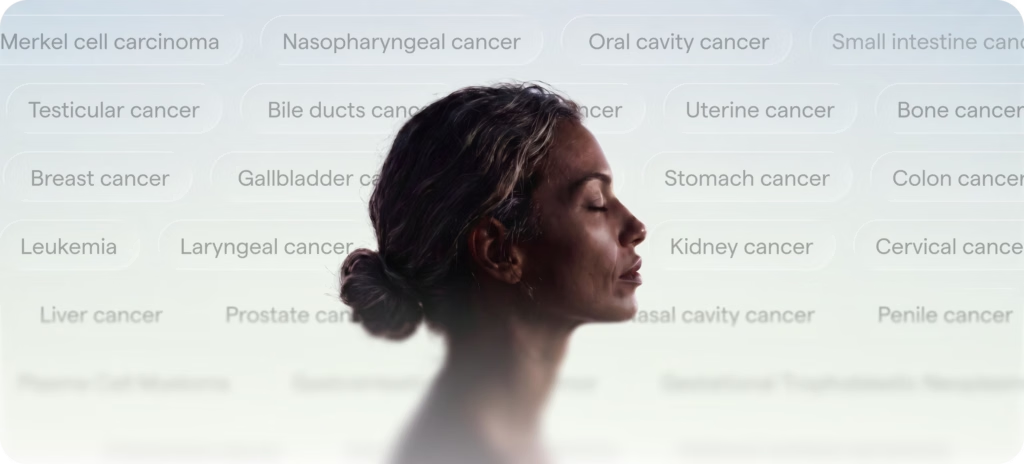
The Galleri test doesn’t run a separate test for each cancer. It looks for one cancer signal that’s shared across many cancer types. In clinical research, that signal was detected across more than 50 types of cancer, including many that don’t have a routine screening test today:¹
A
- Adrenal Cortical Carcinoma
- Ampulla of Vater
- Anus
- Appendix, Carcinoma
B
- Bile Duct, Distal
- Bile Duct, Intrahepatic
- Bile Duct, Perihilar
- Bladder, Urinary
- Bone
- Breast
C
- Cervix
- Colon and Rectum
E
- Esophagus and Esophagogastric Junction
G
- Gallbladder
- Gastrointestinal Stromal Tumor
- Gestational Trophoblastic Neoplasms
K
- Kidney
L
- Larynx
- Leukemia
- Liver
- Lung
- Lymphoma (Hodgkin and Non-Hodgkin)
M
- Melanoma of the Skin
- Merkel Cell Carcinoma
- Mesothelioma, Malignant Pleural
N
- Nasal Cavity and Paranasal Sinuses
- Nasopharynx
- Neuroendocrine Tumors of the Appendix
- Neuroendocrine Tumors of the Colon and Rectum
- Neuroendocrine Tumors of the Pancreas
O
- Oral Cavity
- Oropharynx (HPV-Mediated, p16+)
- Oropharynx (p16-) and Hypopharynx
- Ovary, Fallopian Tube and Primary Peritoneum
P
- Pancreas, Exocrine
- Penis
- Plasma Cell Myeloma and Plasma Cell Disorders
- Prostate
S
- Small Intestine
- Soft Tissue Sarcoma of the Abdomen and Thoracic Visceral Organs
- Soft Tissue Sarcoma of the Head and Neck
- Soft Tissue Sarcoma of the Retroperitoneum
- Soft Tissue Sarcoma of the Trunk and Extremities
- Soft Tissue Sarcoma Unusual Histologies and Sites
- Stomach
T
- Testis
U
- Ureter, Renal Pelvis
- Uterus, Carcinoma and Carcinosarcoma
- Uterus, Sarcoma
V
- Vagina
- Vulva
The Galleri test does not detect a signal for all cancers, and not all cancers can be detected in the blood. False positive and false negative results do occur.
How accurate is the Galleri test? What the research shows
Results from PATHFINDER 2, a registrational study of the Galleri test in its intended-use population²:
- Nearly 7X more cancers found alongside routine screening.*
- 70% detection rate for a group of 12 deadly cancers.
- 53% were caught at stage I or II, when cure is most possible.
*Includes screening in the US for breast, cervical, colorectal, and lung cancers.
12-month episode sensitivity was 69.8% for a prespecified group of 12 cancer types responsible for approximately two-thirds of U.S. cancer deaths, including: anus, bladder, colon/rectum, esophagus, head and neck, liver/bile duct, lung, lymphoma, ovary, pancreas, plasma cell neoplasm, and stomach.
What do Galleri test results mean?
There are two possible results, and Felix supports you at every step:
No Cancer Signal Detected: About 99 in 100 people get this result.² It does not rule out cancer. Keep up with the routine screening your practitioner recommends, retest next year, and reach out to your Felix healthcare practitioner any time you need support.
Cancer Signal Detected: This result comes back for roughly 1 in 100 people.² It means cancer-associated DNA was found in your sample, along with a prediction of where in the body it came from. It is not a diagnosis. Follow-up testing is needed to confirm whether cancer is present, so your Felix healthcare practitioner will arrange a follow-up to discuss next steps.
Is the Galleri test diagnostic?
No. The Galleri test is not diagnostic. If a cancer signal is detected, further diagnostic testing in person is needed to confirm cancer. The test does not detect a signal for all cancers, and not all cancers can be detected in the blood. False positive and false negative results do occur. Talk to your healthcare provider to determine if additional testing is needed.
Who should get the Galleri test?
The Galleri test is recommended for adults with an elevated risk for cancer, such as those age 50 or older. It can be a useful option for adults who want more visibility beyond standard screening pathways, especially for cancers that don’t have routine screening tests today.
It is not recommended for people who are pregnant, 21 years old or younger, or undergoing active cancer treatment.
Galleri is available by requisition only, through your Felix healthcare practitioner.
How the Galleri test will work at Felix
Multi-cancer early detection is coming soon as an add-on for Felix Longevity members, alongside the rest of your health data.
- Answer a few questions about your health.
- Complete your lab work from home.
- Get detailed results and clear next steps in your Felix account.
The Galleri test can be taken annually as part of an ongoing, proactive screening strategy.
How much does the Galleri test cost at Felix?
Felix’s Longevity program starts at $299 per year, and Galleri will be available as a $1,650 add-on.
What to know about paying:
- Galleri is an add-on to Felix Longevity, so you’ll need a Longevity membership to order it.
- No tax is added to the $1,650.
- You’re only charged if a Felix healthcare practitioner orders the test. Your payment is authorized at checkout and charged once a healthcare practitioner approves it.
Frequently asked questions
How many cancers does the Galleri test screen for?
The Galleri test screens for a signal associated with more than 50 types of cancer from a single blood draw.¹ See the full list of cancer types. A Cancer Signal Detected result does not diagnose cancer on its own, but it can indicate that follow-up diagnostic evaluation is warranted.
Does the Galleri test replace my regular cancer screening?
No. The test does not detect all cancers and should be used in addition to the routine cancer screening tests your healthcare provider recommends.
How often should I take the Galleri test?
The Galleri test can be taken annually as part of an ongoing proactive screening strategy.
Is the Galleri test available in Canada?
Felix is bringing the Galleri test to Longevity members in Ontario and BC soon. Join the waitlist to be notified when it’s available.
Where will I get my results?
Results are reported through your Felix account. If a signal is detected, the report will also show the most likely tissue of origin to help guide next steps with your care team.
How much does the Galleri test cost in Canada?
At Felix, Galleri will be available as a $1,650 add-on to the Longevity program, which starts at $299 per year.
Can I get the Galleri test without a Longevity membership?
At Felix, Galleri is offered as an add-on to Longevity, so you’ll need a Longevity membership to order it.
When will I be charged for the Galleri test?
Only if a Felix healthcare practitioner orders the test for you. Your payment is authorized at checkout and charged after approval.
Ready to take a more proactive approach to your health?
Multi-cancer early detection is coming soon for Felix Longevity members.
References
- Klein EA, Richards D, Cohn A, et al. Clinical validation of a targeted methylation-based multi-cancer early detection test using an independent validation set. Ann Oncol. 2021;32(9):1167–77. doi:10.1016/j.annonc.2021.05.806
- Giridhar KV, et al. Safety and performance results from PATHFINDER 2 (PF2), a registrational study of a multi-cancer early detection (MCED) test in an intended-use population [presentation]. ASCO Annual Meeting; 2026 May 31; Chicago. asco.org/abstracts-presentations/260912
- Liu MC, Oxnard GR, Klein EA, et al. Sensitive and specific multi-cancer detection and localization using methylation signatures in cell-free DNA. Ann Oncol. 2020;31(6):745–59. doi:10.1016/j.annonc.2020.02.011
- Schrag D, Beer TM, McDonnell CH, et al. Blood-based tests for multi-cancer early detection (PATHFINDER): a prospective cohort study. Lancet. 2023;402:1251–60. doi:10.1016/S0140-6736(23)01700-2
Galleri is a registered trademark of GRAIL, Inc.